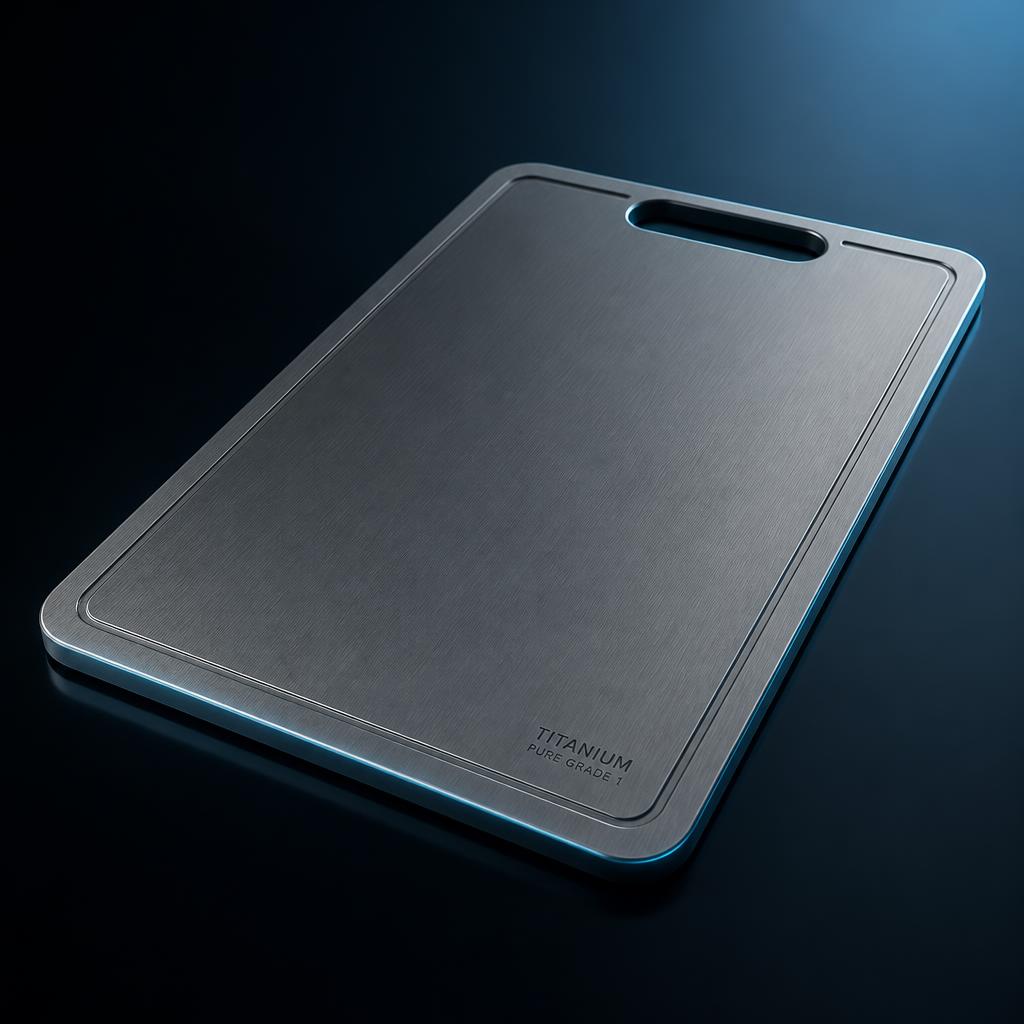
What exactly is the Katori Titanium Cutting Board?
The Katori Titanium Cutting Board is a modern replacement for the wooden block and the plastic sheet that have shared Canadian countertops for decades. Instead of a fibrous or polymer surface, you prepare food on a solid, finished titanium-alloy plate. That single material change removes most of the compromises people have simply learned to live with: the wooden board that smells like garlic three days later, the plastic board that turns grey and grooved after a season of use, the bamboo board that splits along a glue line the first time it goes through the dishwasher.
Titanium is used in surgical implants, aerospace structures and marine hardware for the same three reasons that make it excellent in a kitchen: it is corrosion resistant, it is remarkably strong for its weight, and it is biologically inert. An inert, non-porous surface does not react with acidic tomato juice, lemon, vinegar or marinade, and it does not hold on to whatever you cut last. What you rinse off is genuinely gone.
Canadian buyers tend to arrive at this product from one of two directions. Some are focused on hygiene — a household that cooks a lot of chicken and fish and wants a surface that can be sanitised with confidence. Others are focused on waste — people who have replaced plastic boards every year and are tired of both the expense and the microplastics research they keep reading about. The board answers both concerns with the same design decision.
Why non-porous matters more than people think
Food safety agencies have studied cutting boards for years, and the recurring theme is not the material itself but what happens to the material over time. A brand-new plastic board cleans beautifully. A plastic board with two hundred knife scores is a different object: each groove is a shelter that a sponge cannot reliably reach, and warm protein residue inside those grooves is exactly what bacteria need. Wood behaves differently — it has natural antibacterial properties and pulls moisture below the surface — but it also cannot be sanitised with boiling water or a dishwasher cycle without eventually cracking or warping.
A titanium surface sidesteps the whole argument. There is no absorption, so nothing travels below the surface. There is no deep scoring pattern from ordinary slicing, so there are no shelters to clean out. Soap, hot water and thirty seconds of attention return the board to a genuinely clean state. For households cooking for children, elderly family members, pregnant women or anyone immunocompromised, that predictability is the real product.
The microplastics point is worth stating plainly, without exaggeration. When you slice on polyethylene, some material comes off — that is what the visible knife marks are. Research over recent years has drawn attention to how much of that can end up in prepared food. A metal board does not shed plastic because there is no plastic to shed. Whether or not you consider household microplastics a settled health question, removing the source from your prep station is a simple, permanent fix.
Everyday performance in a real kitchen
Prep and slicing
In use, the board feels closest to a professional stainless prep table. The surface is flat and firm, so food does not rock under the blade, and portioning is precise. Diced onion stays where you put it instead of disappearing into a groove. The board is heavy enough to feel planted but still light enough to lift, carry to the stove and slide ingredients from with one hand.
Odours and cross-contamination
This is where most owners notice the difference within the first week. Cut garlic, then rinse and cut apple — the apple tastes like apple. Break down a salmon fillet, wash the board, and there is no fish ghost waiting for you tomorrow. If you keep separate boards for raw protein and produce, one titanium board can honestly replace that system, though many cooks still keep two for workflow reasons rather than safety ones.
Cleaning and storage
Clean-up is the most underrated benefit. No oiling schedule. No standing it on edge for a day to dry. No worrying that the dishwasher will destroy it. Hot soapy water and a cloth handle daily use; a baking-soda paste or a diluted vinegar wipe restores the finish if anything ever looks dull. It stores flat in a cupboard, on a rack, or leaning behind the sink without absorbing moisture.
Knife care: the honest answer
The question every serious cook asks about a metal board is what it does to a blade. The honest answer is that technique matters more than material. Chopping down hard with a cleaver, scraping vegetables across the surface with the cutting edge, or dragging the blade sideways will dull a knife on any board, including end-grain maple. Slicing with normal pressure, lifting the blade rather than scraping it, and using the spine or a bench scraper to move food will keep your edge in good shape. A few passes on a honing rod every week or two is normal maintenance for anyone who cooks daily, regardless of what they cut on.
If you own thin, hard Japanese knives at high hardness and you are protective of them, many cooks pair a titanium board for proteins and clean-up-critical work with a wooden board for long vegetable sessions. That combination gives you hygiene where it matters and edge comfort where it matters.
Specifications at a glance
| Surface material | Titanium-finished alloy plate |
|---|---|
| Typical sizes | Medium and large prep sizes |
| Base | Non-slip silicone feet / edge grip |
| Care | Hand wash or dishwasher safe |
| Best for | Meat, fish, poultry, produce, allergen separation |
| Shipping | Canada-wide, tracked delivery |
Exact dimensions, weight and included accessories depend on the variant and current bundle, so confirm the listing details on the official page before ordering.
Who should buy it — and who probably shouldn't
It is a strong fit if you cook raw meat, poultry or seafood regularly; if you manage food allergies at home and need genuinely separated, sanitisable surfaces; if you are replacing plastic boards every year and want to stop; if you run a small food business, catering setup or food truck where inspection- ready hygiene matters; or if you simply want one piece of kitchen equipment you never have to think about again.
It is a weaker fit if you want the soft acoustics and give of end-grain wood, if your kitchen runs entirely on ultra-hard specialty blades used for heavy chopping, or if you want a board that doubles as a rustic serving platter. Those are preference issues rather than quality issues, and knowing them up front is how you avoid a return.
Price, bundles and buying safely in Canada
Pricing changes with promotions, and multi-board bundles usually carry the lowest per-unit cost — which is why many households order two, one for proteins and one for produce. Rather than quote a figure that may be stale by the time you read this, check the live price on the official store, where Canadian shipping and any current discount are calculated at checkout.
Buy through the official page rather than a marketplace reseller. It is the only way to be certain you receive the genuine product, the correct finish and the manufacturer's guarantee, and the only way a refund or replacement claim can be processed cleanly. Marketplace listings for popular kitchen products attract look-alikes at similar prices with none of the material specification behind them.
Delivery inside Canada is tracked and typically arrives within about five to ten business days depending on the province. Full details are set out in our refund and shipping policy.
Getting the most out of your board
Wash it before first use with warm soapy water. Place it on a dry counter, or on a thin silicone mat if your surface is very slick. Use the whole board rather than one favourite corner, so the finish wears evenly. Rinse promptly after acidic or heavily pigmented ingredients like beets and turmeric. Avoid steel wool and abrasive powders — they are unnecessary and they scratch. Once a month, a baking-soda paste followed by a hot rinse and a dry cloth brings the surface right back to new.
Frequently asked questions
Will a titanium board dull my knives?
Used properly it should not. The Katori board is designed with a hard but forgiving finished surface, and it is a slicing surface rather than a chopping anvil. Heavy cleaver work and aggressive scraping with the edge of the blade will dull any knife on any board. Slice with normal pressure, scrape with the spine of the knife or a bench scraper, and honing every couple of weeks keeps your edge exactly where it should be.
Is it safe for raw meat and fish?
Yes — that is the strongest argument for a non-porous board. Because liquid cannot penetrate the surface, raw protein juices stay on top where soap and hot water remove them completely. There is no soaked-in residue for bacteria to survive in, which is where wooden and heavily scored plastic boards get into trouble.
Does it slide on the counter?
The board is built to sit stable with grip elements underneath. On a very slick countertop a damp paper towel or thin silicone mat under the board removes any movement at all — a good habit with any board.
Is it noisy to cut on?
It is a firmer sound than wood, similar to cutting on a quality stainless surface. Most users adapt within a session, and the trade for hygiene and durability is one nearly everyone finds worth it.
How do I clean it?
Hot water and dish soap for daily use. For a deep clean, a paste of baking soda and water or a diluted vinegar rinse restores shine and removes any lingering film. Avoid steel wool, which can scratch the finish.
Is it available in Canada?
Yes. Orders placed through the official store ship Canada-wide with tracking. Availability, pricing and current bundle discounts are always confirmed at checkout.
Final verdict
The Katori Titanium Cutting Board is not trying to be a charming piece of kitchen furniture. It is trying to be the last cutting board you buy, and on the measures that matter — hygiene, durability, odour control and the absence of shedding plastic — it makes a very convincing case. The trade-offs are real but small: a firmer feel, a brighter cutting sound, and a technique adjustment that takes about one dinner service to internalise.
For Canadian households that cook often and care about a genuinely clean prep surface, it is one of the more sensible upgrades available in the kitchen. If you still have questions about sizes, bundles, delivery times or an order already placed, contact us directly — we answer every message.